Finder’s RBA Survey: 2 in 5 experts say the RBA will raise cash rate


Experts are divided on whether households should prepare for a second consecutive interest rate rise, according to a new Finder poll.
In this month's Finder RBA Cash Rate Survey™, 37 experts and economists weighed in on future cash rate moves and other issues relating to the state of the economy.
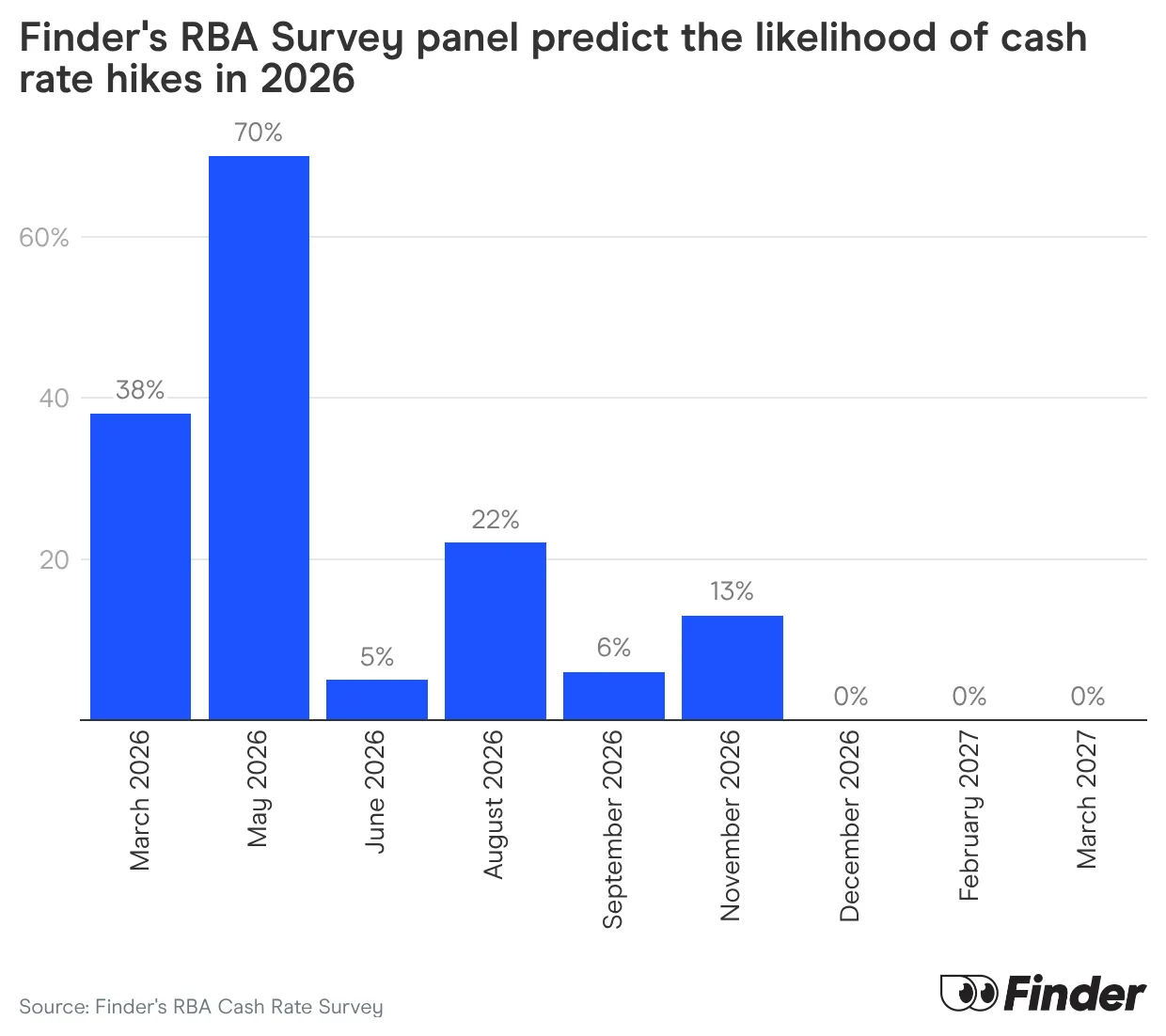
More than half of panellists (62%, 23/37) expect the RBA to hold the cash rate on Tuesday, leaving 38% (14/37) predicting a hike.
An overwhelming 84% of experts do not expect a single rate cut over the next 12 months.
Graham Cooke, head of consumer research at Finder, said there's a clear mix of opinions.
"We're seeing a real tug-of-war in the forecasts. While all four of the big banks are predicting a hike, some experts in our survey aren't convinced the RBA will move just yet.
"Between the volatility in the Middle East pushing up fuel prices and the RBA's need to rein in inflation, it's a high-stakes guessing game for everyone.
"There's no meeting in April so the board may be moved to act now. A rate hike would put immense pressure on household budgets that are already stretched thin," Cooke said.
Shane Oliver from AMP is anticipating a hike.
"We expect that the RBA will raise rates again at its March meeting reflecting concerns about a further boost to inflation and inflation expectations as a result of higher energy prices flowing from the US/Israel war with Iran at a time when inflation is already above target," Oliver said.
Dr Andrew Wilson from My Housing Market agrees a hike is imminent, noting, "[The] latest RBA narrative indicates higher interest rates in the face of high and rising inflation – with the oil wild card now in play," Dr Wilson said.
Adjunct Professor and Executive-in-Residence with the Queensland University of Technology Noel Whittaker is tipping a hold.
"This is being written at a time of war, with clear indications that the disruption will affect commodity prices, including oil. This is bound to have an inflationary effect on Australia, as it will in most other countries.
"But in my view, this is no time for the Reserve Bank to be raising interest rates. There's no point making Australian householders pay more on their mortgage to combat inflation that is not of this country's making. The prudent course would be to hold rates steady and wait until at least the next meeting to see how events unfold," Whittaker said.
Leanne Pilkington from Laing+Simmons is also predicting a hold.
"Uncertainty rules at the moment.
"The war in the Middle East is impacting oil prices in the immediate term but has the potential to cause economic damage too. We think the sensible path is to hold rates steady until a clearer picture emerges," Pilkington said.
A rate hike will cost the average borrower an extra $2,805 a year (compared to the start of this year)
Aussies with the average home loan of $736,259 will have to fork out $2,805 more per year on their mortgage (compared to what they were paying before the RBA started hiking the cash rate this year) if the cash rate rises by 25 basis points in March.
On a $1 million mortgage, the same hike would cost a homeowner $3,810 more a year in interest compared to what they were paying at the start of the year.
Cooke said now was the time to act.
"If you don't know what interest rate you're paying on your mortgage, or haven't looked to see if you can get a better deal, you're probably paying too much.
"The difference between the average market rate and the best available is significant.
"Negotiating even a small discount with your lender, or refinancing to a better deal, could effectively cancel out the impact of next week's predicted rise," Cooke said.
Experts believe the RBA doesn't have a handle on inflation
The majority of experts who weighed in* (72%, 21/29) do not believe the RBA has inflation under control.
Scott Kuru from Freedom Property Investors said, "It's clear the RBA is worried about inflation, but they don't seem to have a great handle on reading the economic tea leaves (after all, that's their job) in a timely fashion.
"They waited far too long to start raising rates in 2022, and on reflection, their decision to lower the cash rate for a third time in August last year was probably premature," Kuru said.
Mark Crosby from Monash University said the RBA has allowed inflation to be above target for too long, resulting in excessive wage pressures.
"Public sector spending has exacerbated these problems," Crosby said.
Please reach out for the full list of these comments.
*Experts are not required to answer every question in the survey.
Here's what our experts had to say about the cash rate:
Evgenia Dechter, UNSW (Increase): "Inflation is still above target and GDP growth has been stronger than expected. With rising oil prices and global uncertainty, the RBA may consider a further rate increase."
Matthew Greenwood-Nimmo, University of Melbourne (Increase): "I suspect the RBA will raise the cash rate. There are several reasons, including the risk of inflation expectations drifting upward the longer that inflation is above target, and the additional inflationary pressure that is likely to come from energy market disruptions associated with the conflict in the Middle East."
Dr Andrew Wilson, My Housing Market (Increase): "Latest RBA narrative indicates higher interest rates in the face of high and rising inflation - with the oil Wild Card now in play."
Shane Oliver, AMP (Increase): "We expect that the RBA will raise rates again at its March meeting reflecting concerns about a further boost to inflation and inflation expectations as a result of higher energy prices flowing from the US/Israel war with Iran at a time when inflation is already above target."
Stella Huangfu, University of Sydney (Increase): "The CPI released in February showed that core inflation for the 12 months to January was 3.4%, still above the 2-3% target band. In addition, the conflict involving Iran has pushed up oil prices, which could add further inflation pressure through higher fuel costs. It is hard to tell at the moment whether there will be another increase in May, as the board will likely wait to see more data and how these developments affect inflation."
Nicholas Frappell, ABC Refinery (Australia) Pty Ltd (Increase): "Persistent above-target inflation, with the RBA likely to wait after March, especially given current shocks."
Kyle Rodda, Capital.com (Increase): "Recent commentary from the RBA has been explicit that this meeting is live. There's also been the clear suggestion from Deputy Governor Hauser that he favours a hike. The RBA seems to want to pull out of the market at least two of the cuts from last year. There's an argument that the central bank has time to wait and read the play for a little longer. But inflation does appear to be tracking above forecasts and that seems to be inspiring urgency."
Geoffrey Kingston, Macquarie University Business School (Increase): "Recent data on actual inflation, expected inflation (both survey data and breakevens), the labour market and gross domestic product all indicate the Bank will probably hike this month. Failing that outcome, the Bank should hike in May. In either event, there should be a further rise in the second half of this year."
James Morley, University of Sydney (Increase): "The sharp rise in oil prices given the conflict in the Middle East will feed through to higher inflation than previously expected over the next 12 months. The RBA might have previously held off on a second rise in the cash rate until more quarterly inflation data came in. But they are likely to raise rates this meeting to show a response to upcoming inflation pressures due to the oil price spike. Assuming Q1 inflation comes in higher than forecast, they will also likely raise rates at the May meeting. After that, it will be very data dependent. If the oil price spike is followed by a global recession, the RBA would obviously start cutting rates. But if oil prices fall quickly after a faster than expected resolution of war in the Middle East, then the RBA would let the hikes in February, March, and May work through the economy. If the inflation forecasts get significantly higher without as much weakening of the real economy, then the RBA is likely to raise rates further in future meetings later this year."
Nalini Prasad, UNSW Sydney (Increase): "Inflation has been higher than expected for longer than expected. I think the RBA will want to take out insurance to prevent future upward pressure on prices. They can achieve this by increasing the cash rate."
Mala Raghavan, Tasmanian School of Economics and Finance (Increase): "Geopolitical tensions and the resulting disruption to global oil supplies are placing upward pressure on energy prices, increasing both actual inflation and inflation expectations. At the same time, Australia's labour market remains notably tight, with unemployment at low levels and wage growth persisting, while consumer spending has only softened marginally despite higher borrowing costs. These dynamics suggest that inflationary pressures may prove more persistent than previously anticipated. Given this outlook, the Reserve Bank of Australia may feel compelled to raise the cash rate further to prevent inflation from becoming entrenched and to ensure that long-term expectations remain well anchored."
Jakob B. Madsen, UWA (Increase): "Trimmed mean inflation was 3.4% and has recently been drifting upwards."
Brodie Haupt, WLTH (Increase): "The decision for May will remain highly dependent on the inflation data and whether the RBA board sees clear evidence that inflation is moving sustainably toward its target band. While the Australian economy has demonstrated resilience in the past, ongoing global tensions could still pose risks to the outlook."
Peter Boehm, Pathfinder Consulting (Increase): "Based on recent comments by the RBA Governor, the above target inflation rate, excessive federal government spending and demand exceeding supply for goods and services, I see no other option but for the RBA to lift rates now to help dampen demand. Further, it would not be prudent for the RBA to wait until May (there's no meeting in April) to see if inflation is moderating. There is no indication that it will and so there is no reason not to increase rates now, rather than wait until economic and financial matters become even worse."
Scott Kuru, Freedom Property Investors (Hold): "It's clear there are inflation pressures in the economy, but the RBA would be madder than a March hare to raise interest rates this month when we have see-sawing oil prices and stock markets because of the chaos in the Middle East. Better to wait until things settle down and take a sober look at the data after the quarterly inflation numbers come out at the end of April."
Tomasz Wozniak, University of Melbourne (Hold): "Rather not! I don't know! What do you think? According to my forecasting system, the cash rate is set to hold steady. Despite the forecast mean being on a clear upwards trajectory, the forecast intervals include the current cash rate value decisively. I'm sticking with my call: HOLD! My forecasts are available at: https://forecasting-cash-rate.github.io/"
Anthony Waldron, Mortgage Choice (Hold): "In such an uncertain environment, I expect the RBA will hold the cash rate in March. The Board needs more time to assess potential effects from global conflict as well as the impact of the February rate hike. Governor Bullock has been clear that monetary policy decisions must be data driven. But with updated inflation and labor data not published until after this month's meeting, the Board may not have all the information it needs to make a change to the cash rate just yet."
Mark Crosby, Monash University (Hold): "RBA is likely to hold this month due to global uncertainty, but with inflationary pressures increasing the next move is likely to be a raise."
Tim Reardon, HIA (Hold): "Inflation is being driven by the cost of housing, which is a product of the Supply/Demand imbalance. This won't improve quickly."
Micaela Fuchila, Jarden (Hold): "Hawkish bias makes the RBA less likely to look through inflationary shocks."
Garry Barrett, University of Sydney (Hold): "Stubborn inflationary pressures, energy prices."
Trent Wiltshire, RLB (Hold): "The RBA will raise rates later in 2026 to lower inflation, but it will wait for the full March quarter CPI data and to see how the Middle East war affects inflation, inflation expectations and growth."
Adj Prof Noel, Whittaker (Hold): "This column is being written at a time of war, with clear indications that the disruption will affect commodity prices, including oil. This is bound to have an inflationary effect on Australia, as it will in most other countries. But in my view, this is no time for the Reserve Bank to be raising interest rates. There's no point making Australian householders pay more on their mortgage to combat inflation that is not of this country's making. The prudent course would be to hold rates steady and wait until at least the next meeting to see how events unfold."
Nicholas Gruen, Lateral Economics (Hold): "It is best to wait it out this month, but if by next month it's clear we're in for higher oil prices for a while, then inflation becomes a worry. Further down the track the global economy will slow in response and at that point, rates will be lowered."
Jeffrey Sheen, Macquarie University (Hold): "Rising long-term inflation expectations among businesses and households risk becoming entrenched above the Reserve Bank of Australia's target. While this could justify modest cash-rate increases this year, the RBA may like to wait given the uncertainty over how the Middle East conflict will affect oil prices, inflation and output."
Leanne Pilkington, Laing+Simmons (Hold): "Uncertainty rules at the moment. The war in the Middle East is impacting oil prices in the immediate term but has the potential to cause economic damage too. We think the sensible path is to hold rates steady until a clearer picture emerges."
Mathew Tiller, LJ Hooker Group (Hold): "Inflation is still too high for the RBA, but after lifting rates in February and with uncertainty around global conflicts, the bank should wait for the impact of recent events to become clearer. For the property market, this means conditions should remain steady. New listings have risen, but steady demand should continue to support price growth, particularly at the more affordable end of the market."
David Robertson, Bendigo Bank (Hold): "The RBA are likely to continue their tightening cycle this year especially with the intensifying conflict in the Middle East adding further to inflationary risks, although I suspect they will hold in March and await more data and overseas developments. We see the next hike in May."
Tim Nelson, Griffith University (Hold): "With so much uncertainty in relation to global conflict and energy prices increasing on the back of restricted supply, it is challenging to see interest rates shifting until further clarity is forthcoming on this global issues."
Stephen Miller, GSFM (Hold): "Inflation pressures persist and are potentially exacerbated by both domestic conditions (labour costs) and the ME conflict. Activity growth is solid and the labour market remains in good shape."
Michael Yardney, Metropole Property Strategists Pty Ltd (Hold): "The direction of interest rates over the next year is still uncertain, because the Reserve Bank is trying to balance two competing forces - stubborn inflation on the one hand and rising global uncertainty on the other. Inflation has proven stickier than expected, still running above the RBA's 2-3% target band, and may take several years to return to the midpoint sustainably. At the same time, geopolitical tensions overseas are pushing up energy prices, which can feed into inflation through higher transport and production costs. Oil shocks historically act like a tax on the global economy. They push prices higher while slowing economic growth. So the Reserve Bank is in a tricky position. If inflation remains persistent, we could see another small rate rise. But if global instability slows economic growth, the RBA may instead pause and wait to see how things play out."
Dale Gillham, Wealth Within (Hold): "The US and Iran conflict has caused concern of the stability of energy and supply chains, so I expect we may not see inflation go down in the short term."
Craig Emerson, Emerson Economics (Hold): "Petrol prices will rise from the war in the Middle East, which will increase the CPI further beyond the 2-3 per cent range. The RBA will succumb to pressure to increase the cash rate."
Saul Eslake, Corinna Economic Advisory Pty Ltd (Hold): "Given the RBA's latest forecasts for inflation – which prior to the outbreak of war in the Middle East I thought were a little too bearish, but it's their forecasts which matter for monetary policy decisions, not mine – they will almost certainly need to move monetary policy further into restrictive territory in order to be able, credibly, to forecast 'underlying' inflation returning to the target band in an acceptable time frame."
Stephen Koukoulas, Market Economics (Hold): "Inflation will fall more than the RBA is currently forecasting."
Matt Turner, GSC Finance (Hold): "Fuel prices and supply chain disruption from the Middle East will likely keep inflation higher for longer, ultimately this will mean higher rates and giving back cuts from last calendar year."
Cameron Murray, Fresh Economic Thinking (Hold): "Honestly it merely reflects an expectation of inflation. Globally inflation has fallen, so the recent uptick in Australia would likely be temporary."
Ask a question