Uncover how to stop money leaks, achieve your investing goals and start building your wealth.
4.7 based on 826 reviews
The Finder Wealth Building Masterclass is now over...
Thanks to everyone who attended - we hope it helped you on your own wealth-building journey. Stay tuned for more Finder Masterclasses in future.
Due to the overwhelming amount of questions we received as part of the masterclass, we've decided to feature them all here - along with answers from our expert panellists.
1. Best type of account for online savings, investments, and trading ETFs? - Teddy J
A high interest savings account is going to get you the best return on your money for savings – review some of your options here.
Exchange-Traded Funds (ETFs) tracking diversified indices like the ASX 200, S&P 500, or global markets (e.g., Vanguard or Betashares ETFs) are excellent options.
Look for low management fees, broad diversification and strong long-term performance. You can learn more in our guide to ETFs or our recommendation of the top 10 ETFs.
2. How can I build my savings in the best way? - Calver B
Start by budgeting to identify and cut out unnecessary expenses – that way, you can free up some 'risk free' extra money and use it to start building your savings balance.
Set up an automatic savings plan where a portion of your income goes directly into a high-interest savings account – it could be as little as $10 a week at the beginning, if that's all you can afford.
It's less about the dollar value and more about building a consistent savings habit. Eventually, once you've built a savings balance you're comfortable with, you can start investing into a diversified ETF portfolio. Consider apps like Raiz or Spaceship for micro-investing.
5. Should I invest in real estate or stocks? - Vladi R
This really depends on your personal goals, your budget and your long term investment goals. A couple of things to keep in mind:
Real estate offers leverage (where you can borrow money to invest) and long-term capital growth, but requires a decent amount of capital upfront.
Stocks/ETFs provide liquidity, diversification and lower entry transaction costs. Choose based on your financial goals, risk tolerance and time horizon.
6. Best way to build wealth for those who've missed the property investment race? - Jim Q
You haven't ever fully missed the boat when it comes to property! There's a few things could you look at if you're still keen to invest in bricks and mortar, such as:
Look at doing a joint venture with someone so it's more achievable to buy
7. Do you agree with Warren Buffett about overheating shares? Should I trust super funds? - Jackie F
Markets may appear overheated, but time in the market often beats timing the market. Diversify within your super and focus on long-term growth.
Trusting a well-performing, low-fee super fund can simplify the process. If you want more data to decide which super fund to trust,Finder's Superannuation Awards highlights the best performer each year.
9. Managing tax requirements for first-time ETF investments - Rachel F
Try and keep your own records of purchase and sale prices, commissions, dates, and distributions.
While some platforms will provide tax reporting this isn't consistent across all platforms so you need to keep track yourself.
Some information may be automatically reported to the ATO and pre-filled on your tax return, but it's your responsibility to ensure that the information is correct.
You could also use apps like Sharesight to track your investments and calculate capital gains for tax time, and even a separate bank account for distributions and reinvestment tracking.
11. What's the best way to start creating wealth - Kelly L
As the old adage says, "time in the market beats timing the market."
The best way to start creating wealth is investing early and consistently and focusing on inflation-beating assets like shares, ETFs, or investment properties.
The earlier you start investing and the more consistent you are about it, the more opportunity for compounding returns, which means more wealth.
13. Best strategies for reliable retirement income - Bernadette H
It depends if you're nearing retirement and need strategies to support you in the near future, or if this is a longer-term strategy and you're looking ahead.
But there's a few things you can keep in mind either way:
Transition to low-volatility investments like bonds and high-yield dividend stocks.
Use annuities for guaranteed income.
Maintain a diversified portfolio to sustain growth.
Consider inflation when calculating retirement needs.
You could try adopting the 50/30/20 rule, which means assigning your income in the following buckets: essentials (50%), discretionary spending (30%), savings/investments (20%).
You can also set up separate accounts for each bucket and have your salary automatically deposited there to help you stick to your spending plan.
21. Can you build wealth even if you're 60? - Nea A
Yes, it's never too late to focus on improving your financial situation.
It's all about taking small, consistent action towards your goals. You could focus on:
Maximising superannuation contributions – the tax benefits can fast-track your ability to grow your wealth. You only pay 15% tax on contributions (up to a cap of $30k per year, including employer contributions), which could be much less than your current tax rate. This gives a big boost to your wealth.
Investing in dividend-paying ETFs or shares to generate an income stream in retirement.
Downsizing your home (or having a plan to downsize in the future) to free up equity.
Delaying the age you plan to retire, to boost the amount of time you have to grow your wealth.
22. How much money will I have in retirement? - Asta G
You can use calculators from your super fund, ASIC's Moneysmart or Finder to get an estimate based on:
Your current super balance.
Any additional super contributions and investment returns.
Other assets including your house.
The amount you'll need in retirement will vary based on your desired lifestyle.
According to the Association of Superannuation Funds of Australia, a single person needs $51,814 a year for a comfortable retirement or $32,930 for a modest retirement.
For couples, it's $73,031 for a comfortable retirement or $47,475 for a modest retirement.
25. Where should I be financially at 33? - Adrian C
This is going to vary for everyone and trying to measure up to a gold standard can often be counter-productive. Comparison is the thief of joy as they say.
Half the battle is simply being willing to improve your financial position.
That said, here are some general ideas for what you might want to focus on:
Cash: Make sure you have an emergency fund that can cover at least 3-6 months of living expenses.
26. Paying more interest than principal – what to do? - Parichuri G
This is often an issue early on in a mortgage, as the interest is based on the outstanding amount and it is highest at the start.
If you are in this position, your interest rate is the most important. Consider refinancing to a lower interest rate from a competitor.
Also, try and pay off as much extra principle as you can early on - this will be easier if you are on a variable loan, but every extra dollar you pay off will save you a lot over the course of your loan.
Start an online business: Many businesses require lots of ongoing work, but you could consider creating digital products or e-books that can generate income with little ongoing maintenance.
Focus on areas with strong population growth, infrastructure, and rental demand (e.g., outer suburbs of major cities or regional hubs like Geelong or Newcastle).
Consumer Finder's Property Investment Index - but don't use this alone, consider it one of many tools you can use to decide where might be best to invest.
35. Best starting point for investing, especially S&P 500 - ClaireF
The best thing to do is to start small with a low-cost investing platform and get low-cost exposure to the S&P 500 via ASX-listed ETFs like IVV (iShares S&P 500 ETF) or SPY (SPDR S&P 500 Trust ETF).
You might also want to use dollar-cost averaging to avoid having to time the market and help develop the habit of regularly investing.
If you've received a sizable inheritance, it might be worth first putting it in a high-interest savings account for a few months to give yourself time to consider your options.
You might also want to contact a financial advisor, but depending on the size of the inheritance, this won't necessarily be cost-effective.
Super is designed to support you in retirement, but it obviously doesn't hurt to be able to lean on supplementary income from other investments or assets.
You should also ensure you're in a low-fee, high-performing fund and have your money in a portfolio with a suitable level of risk.
Compounding interest is the key to growing wealth more quickly over time and the equation is pretty simple - the more you invest and the longer you leave it invested, the higher your returns are likely to be.
Increase income through side hustles, upskilling or job-hopping.
Aggressively reduce your debt, cut unnecessary spending and reinvest your savings into long-term investments.
Make sure your portfolio is sufficiently diversified, with a focus on high-growth investments.
It's going to depend on your financial situation, but if you can afford the costs and mortgage repayments, buying a house can give you financial security.
Renting could make sense if you're still saving for a deposit, or think you can get a better return on your money elsewhere.
You might also want to consider rentvesting, where you buy an investment property somewhere else and then rent in the area you want to live in.
A self-managed super fund may be suitable if you have a balance of $200,000+, giving you greater control over your super but higher fees and a lot more work.
Retail funds are more cost-effective for smaller balances and offer a lot more simplicity, less stress and little ongoing management.
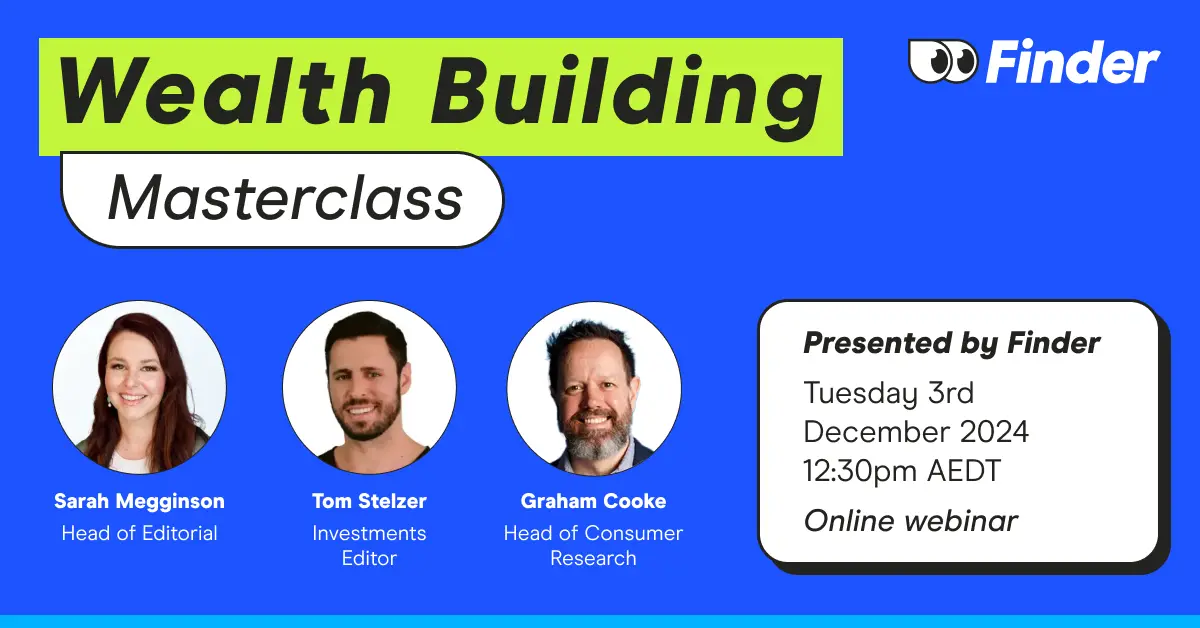
The Finder Wealth Building Masterclass was a free live webinar held on 12.30pm AEDT on 3 December 2024 that aimed to put you in the driver's seat of your finances.
The class was a 60-minute online webinar hosted by Finder's Head of PR and personal finance specialist, Taylor Blackburn.
Taylor pulled insights from Finder's personal finance expert Sarah Megginson, as well as investing guru Tom Stelzer and Finder's head of consumer research, Graham Cooke.
Attendees were guided through the new findings of Finder's Wealth Building Report 2024, how to stop money leaks, achieve your investing goals and lay the foundation for financial freedom.
Here's a closer look at your curriculum:
Part 1: Success leaves clues: how rich Australians build their wealth
The class began with a strong foundation in uncovering the wealth habits and strategies of Australian investors. What factors have contributed to their net wealth and what actions are they taking to grow their finances.
Highlights include: The 3 top habits of successful investors and how to harness each one, so you can grow your wealth.
Part 2: The 4 steps to build wealth
Next we explored the 4 steps to build wealth and chart a smooth path towards creating your dream financial future. We explained the power of reducing unnecessary costs and break-free from money-sapping habits like overspending and impulse buying and replace them with new habits that put money into your pocket. Gain the clarity and confidence to invest and upgrade your money position.
Highlights include: Start seeing new possibilities for wealth accumulation and fast-track ways to multiply your wealth.
Part 3: Upgrade your Financial IQ
The session concluded with a question and answer session where those who have signed up for the workshop can submit their burning money questions.
Highlights include: Get expert advice to help you rise from where you are right now, to where you want to be.
Was this content helpful to you?
Thank you for your feedback!
Get rewarded $$ for switching with Finder Rewards
Find a better deal, save on your bills and get a free gift card. Sign up to be the first to hear about new Finder Rewards.
Important information about this website
Finder is a comparison service. We do not compare every product or every provider in the market.
We make money through commercial arrangements with some of the providers on this site. Products marked 'Sponsored', 'Promoted', 'Featured' or 'Advertisement' appear as a result of a commercial arrangement.
Our editorial content, product reviews and any 'Top Pick' designations are prepared independently of these commercial arrangements.
The default order of products in our tables can be influenced by commercial arrangements. You can re-sort or filter using the controls above each table.
Some content on this site may be generated or supported by AI tools. You should verify details directly with the provider.
Finder is one of Australia's leading comparison websites. We are committed to our readers and stand by our editorial principles.
Our comparison service does not include every product or every provider in the market. Some product issuers offer their products under multiple brands or through associated companies. Where we can, we identify the underlying issuer so you can compare like with like, but you should always check with the provider directly to confirm which brand you are dealing with.
Finder is a comparison website and an intermediary. We are not a product issuer and we do not provide personal financial or credit advice. When you click a link to a product, or apply for a product through our site, you deal directly with the product issuer. We may receive a referral fee, commission or other payment from the issuer if you click through, apply or take out a product. We describe these arrangements in more detail under 'How we make money' below.
Product features, fees, terms and eligibility criteria are set by the product issuer and may change. We rely on information supplied by issuers when we present product details on our site. Before you apply for or take out any product, you should confirm the details directly with the issuer.
We earn revenue from Finder in four principal ways:
Referral fees and commissions. When you click a product link, complete an enquiry form or apply for a product through our site, we may receive a referral fee, commission or other payment from the product issuer. We may also receive payment based on the volume of leads or conversions we send to an issuer.
Sponsored placements. Products marked 'Sponsored', 'Promoted', 'Featured' or 'Advertisement' appear as a result of a commercial arrangement between Finder and the issuer. These labels always indicate a paid placement. We do not use them for editorial choices.
Display advertising. Banner advertising, newsletter advertising and similar display ads on our site are paid by advertisers.
Content sponsorship. Some articles, videos and social media posts are sponsored by an issuer and are clearly labelled as such.
Our editorial opinions, product reviews and any 'Top Pick' designations are prepared independently of these commercial arrangements. A 'Top Pick' is an editorial choice made by our writers and editors based on the criteria described on each comparison page. A 'Top Pick' is not a personal recommendation and does not mean the product is appropriate for your circumstances.
If you would like to know whether we have a commercial arrangement with a specific product issuer, please contact us.
When products are grouped in a table or list, the default order can be influenced by commercial arrangements we have with product issuers. In some categories, sponsored or featured products appear in the top positions of the table by default, and are always labelled as such.
Other factors that influence default order include price, fees and features, and (where relevant) our editorial view of the product.
You can re-sort every comparison table using the controls above the table. You can filter by product features that matter to you. The order you see after re-sorting or filtering is not influenced by commercial arrangements.
Some content on this site is generated or supported by artificial intelligence tools, including our AI-powered assistant FinderBot. AI-generated content may contain errors. Please verify important information directly with the product issuer before making a financial decision. For more information about FinderBot, see the FinderBot Terms of Use and FinderBot Privacy Collection Notice.
Please read our website terms of use and privacy policy for more information about our services and our approach to privacy.
We update our data regularly, but information can change between updates. Confirm details with the provider you're interested in before making a decision.
Our goal is to create the best possible product, and your thoughts, ideas and suggestions play a major role in helping us identify opportunities to improve.