These products offer great value, with a good score across both features and price.
7+
Great
These are competitive products, though they didn't quite get top scores.
5+
Standard
These products might offer less value or command a higher premium than others in the market.
0+
Basic
These products might only offer a basic set of features or aren't very competitive on price.
Key takeaways
You could consider adding cover for your child to an existing life insurance policy to help protect against the financial burden of a serious illness or injury.
While a limited number of providers offer this specific cover, some comprehensive policies allow for critical illness limits of up to $200,000 per child.
Child life insurance is designed to help ease financial stress by covering medical costs, allowing parents to take time off work, or assisting with funeral expenses.
Taking out life insurance for your children is a financial safeguard for you and your family if they were to experience an injury or illness. A convenient feature of generic life insurance policies (that you take out for yourself) is the option to add children to your policy. Read on to see how it works and which policies cover children as well as adults.
Is children’s life insurance essential for your family?
It's understandable if discussing life insurance for your children is uncomfortable. However, there are a few reasons why it is never a bad idea to purchase life insurance for your children.
Children cover can be added on to your cover. Not all providers offer this benefit. We looked at 16 policies and found just 4 give you the option of adding children to your policy.
Reduces financial burdens incurred by sickness or accidents. It might be a depressing thought, but being sick and getting involved in an accident is a probability in life. It could happen to anyone and no one is exempt, not even your children. This could mean extra medical care and purchasing medical equipment needed for rehabilitation - a financial burden can be relieved if your child is properly covered.
Replaces lost income. When your child’s sickness becomes longer than you expected and your presence is called for, there is also the possibility that you or your spouse will take a leave of absence from work for an indefinite period of time if both of you are working. No work, as everybody is aware of, generally means no income. Having children’s life insurance cover the added medical expenses will ease you of your fears how to sustain your daily expenses.
Takes care of the final expenses. Death is scary but is also a reality of life. The death of your child can cause you great emotional and financial stress. It might be difficult to deal with the loss emotionally, but there is something you can do about it financially. Dealing with half of the problem is a big help – a priceless one that you cannot ignore.
With the rising costs on every commodity, funeral expenses are also always on the rise - If you are not prepared for it, you might find yourself being in debt by just burying your child.
Can be used as collateral when your child takes out a mortgage. Some life insurance policies can be used as collateral when you want to secure a loan. This can be helpful to your children in the future when they are applying for a loan.
Compare Life insurance for children
9 of 9 results
Compare other products
Looking for other options? Check out these similar products.
How we picked these
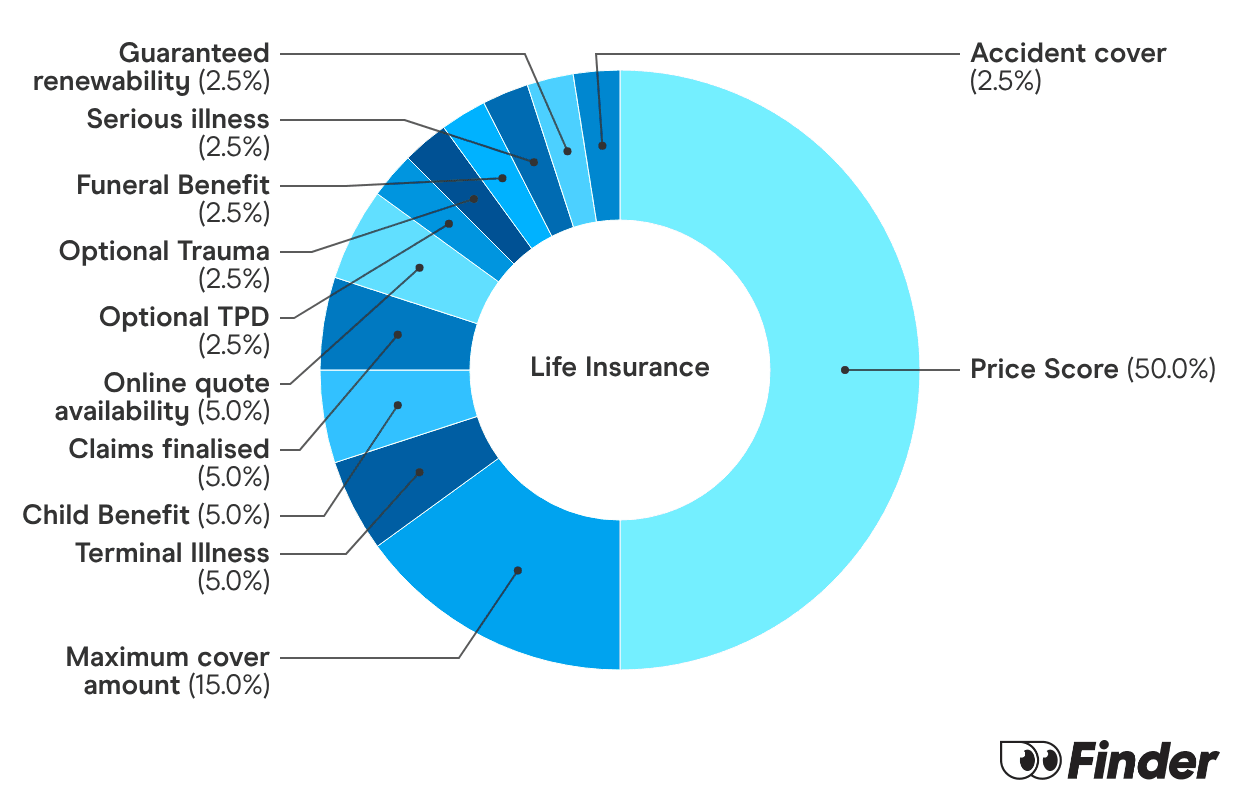
Finder Score - Life Insurance
Life Insurance is a little complicated and a lot overwhelming. That's why we made the Finder Score, to make it easier to compare Life Insurance products against each other. Our experts analysed over 30 products and gave each one a score out of 10.
But a higher score doesn't always mean a product is better for you. Your situation is unique, so your policy choice will be too. Don't think of Finder Score as the final word, but as a good place to start your life insurance comparison.
*Conditions apply. Check the policy disclosure statement (PDS) before purchasing cover.
How to purchase life insurance for your children
Children’s life insurance is basically to cover your child for sickness and accidents. Most insurance providers offer child insurance as an additional feature when you get your own life insurance.
Getting life insurance for your kids is easier because most insurance providers do not require medical or blood tests. Moreover, children’s life insurance is much cheaper than adult insurance because of the fact that kids have longer life expectancy.
Children eligible for this type of insurance are between the ages of 2 and 17 and a citizen of Australia.
So how long does the policy last?
Children’s life insurance benefits expire at an age that varies by insurer. TAL's Child's Critical Illness cover, for example, ends on the policy anniversary before your child's 23rd birthday, and that is also the point at which you can move them onto an adult life insurance policy. Check the PDS for the policy you are looking at, because the expiry and conversion ages differ between providers.
Speak to a trusted advisor to find a policy best suited to your family's needs
Frequently asked questions
Child life insurance generally covers a range of serious health events. This can include specific critical illnesses, such as cancer or major organ disease, certain serious injuries, and, in the tragic event of death. The exact conditions and events covered will vary between policies and insurers, so always check the Product Disclosure Statement for full details.
Yes, most insurers require a child to be at least 2 years old to be added to a life insurance policy. Children's cover is typically available up to the age of 17, with the expiry age varying by insurer.
In most cases, the policyholder, usually a parent or legal guardian, is the beneficiary of a child's life insurance policy. This means the payout would go to the policyholder to help cover financial burdens resulting from the child's illness, injury, or death.
Generally, premiums paid for life insurance, including child life insurance, are not tax deductible in Australia. However, it is always best to seek advice from a qualified financial advisor or tax professional regarding your specific circumstances.
Converting a child's policy to an adult one often allows your child to secure full life insurance cover without needing to undergo new medical assessments. This means any health conditions developed during childhood would not impact their ability to get cover or the cost of their premiums as an adult, which can be a significant financial advantage.
Richard Laycock is Finder’s insights editor after spending the last five years writing and editing articles about insurance. His musings can be found across the web including on MoneyMag, Yahoo Finance and Travel Weekly. Richard studied Media at Macquarie University and The Missouri School of Journalism and has a Tier 1 Certification in General Advice for Life Insurance.
See full bio
James Martin was the insurance editor at Finder. He has written on a range of insurance and finance topics for over 7 years. James often shares his insurance expertise as a media spokesperson and has appeared on Prime 7 News, Insurance News, 7NEWS and The Guardian. An experienced journalist, James' work has featured in publications including The Irish Times, Companies100 and In Business. He holds a Tier 1 General Insurance (General Advice) certification and a Tier 1 Generic Knowledge certification, both of which meet the requirements of ASIC Regulatory Guide 146 (RG146).
See full bio
James's expertise
James
has written
177
Finder guides across topics including:
It’s possible to buy life insurance for your parents. We’ll show you how.
Important information about this website
Finder is a comparison service. We do not compare every product or every provider in the market.
We make money through commercial arrangements with some of the providers on this site. Products marked 'Sponsored', 'Promoted', 'Featured' or 'Advertisement' appear as a result of a commercial arrangement.
Our editorial content, product reviews and any 'Top Pick' designations are prepared independently of these commercial arrangements.
The default order of products in our tables can be influenced by commercial arrangements. You can re-sort or filter using the controls above each table.
Some content on this site may be generated or supported by AI tools. You should verify details directly with the provider.
Finder is one of Australia's leading comparison websites. We are committed to our readers and stand by our editorial principles.
Our comparison service does not include every product or every provider in the market. Some product issuers offer their products under multiple brands or through associated companies. Where we can, we identify the underlying issuer so you can compare like with like, but you should always check with the provider directly to confirm which brand you are dealing with.
Finder is a comparison website and an intermediary. We are not a product issuer and we do not provide personal financial or credit advice. When you click a link to a product, or apply for a product through our site, you deal directly with the product issuer. We may receive a referral fee, commission or other payment from the issuer if you click through, apply or take out a product. We describe these arrangements in more detail under 'How we make money' below.
Product features, fees, terms and eligibility criteria are set by the product issuer and may change. We rely on information supplied by issuers when we present product details on our site. Before you apply for or take out any product, you should confirm the details directly with the issuer.
We earn revenue from Finder in four principal ways:
Referral fees and commissions. When you click a product link, complete an enquiry form or apply for a product through our site, we may receive a referral fee, commission or other payment from the product issuer. We may also receive payment based on the volume of leads or conversions we send to an issuer.
Sponsored placements. Products marked 'Sponsored', 'Promoted', 'Featured' or 'Advertisement' appear as a result of a commercial arrangement between Finder and the issuer. These labels always indicate a paid placement. We do not use them for editorial choices.
Display advertising. Banner advertising, newsletter advertising and similar display ads on our site are paid by advertisers.
Content sponsorship. Some articles, videos and social media posts are sponsored by an issuer and are clearly labelled as such.
Our editorial opinions, product reviews and any 'Top Pick' designations are prepared independently of these commercial arrangements. A 'Top Pick' is an editorial choice made by our writers and editors based on the criteria described on each comparison page. A 'Top Pick' is not a personal recommendation and does not mean the product is appropriate for your circumstances.
If you would like to know whether we have a commercial arrangement with a specific product issuer, please contact us.
When products are grouped in a table or list, the default order can be influenced by commercial arrangements we have with product issuers. In some categories, sponsored or featured products appear in the top positions of the table by default, and are always labelled as such.
Other factors that influence default order include price, fees and features, and (where relevant) our editorial view of the product.
You can re-sort every comparison table using the controls above the table. You can filter by product features that matter to you. The order you see after re-sorting or filtering is not influenced by commercial arrangements.
Some content on this site is generated or supported by artificial intelligence tools, including our AI-powered assistant FinderBot. AI-generated content may contain errors. Please verify important information directly with the product issuer before making a financial decision. For more information about FinderBot, see the FinderBot Terms of Use and FinderBot Privacy Collection Notice.
Please read our website terms of use and privacy policy for more information about our services and our approach to privacy.
We update our data regularly, but information can change between updates. Confirm details with the provider you're interested in before making a decision.
Our goal is to create the best possible product, and your thoughts, ideas and suggestions play a major role in helping us identify opportunities to improve.